

Exploring the Plants of Israel Series
(2) Thornbushes of Israel and the Crown of Thorns of Christ
“Then all the trees said to the thornbush, ‘Come and be our king.’ The thornbush said to the trees, ‘If you really want to anoint me king over you, come and take refuge in my shade; but if not, let fire come out of the thornbush and consume the cedars of Lebanon!’” (Judges 9:14-15)
“Then Jesus came out wearing the crown of thorns and the purple robe. Pilate said to them, ‘Here is the man!’” (John 19:5)
In Israel, more than 70 species of plants with thorns grow, and over 20 of these are mentioned in the Bible. Among the plant names in the Bible, few are as often misunderstood or arbitrarily translated as “thornbush.” It’s unlikely that the biblical figures had specific names for the thorny plants they encountered. Even today, we often refer to any plant with thorns simply as a “thornbush” without using its precise name. It’s also possible that the original authors or prophets of the Bible were not clearly distinguishing the various names they used. Moreover, scholarly efforts to match the twenty thorn-related names in the Bible to actual plant species have often resulted in errors and failure.
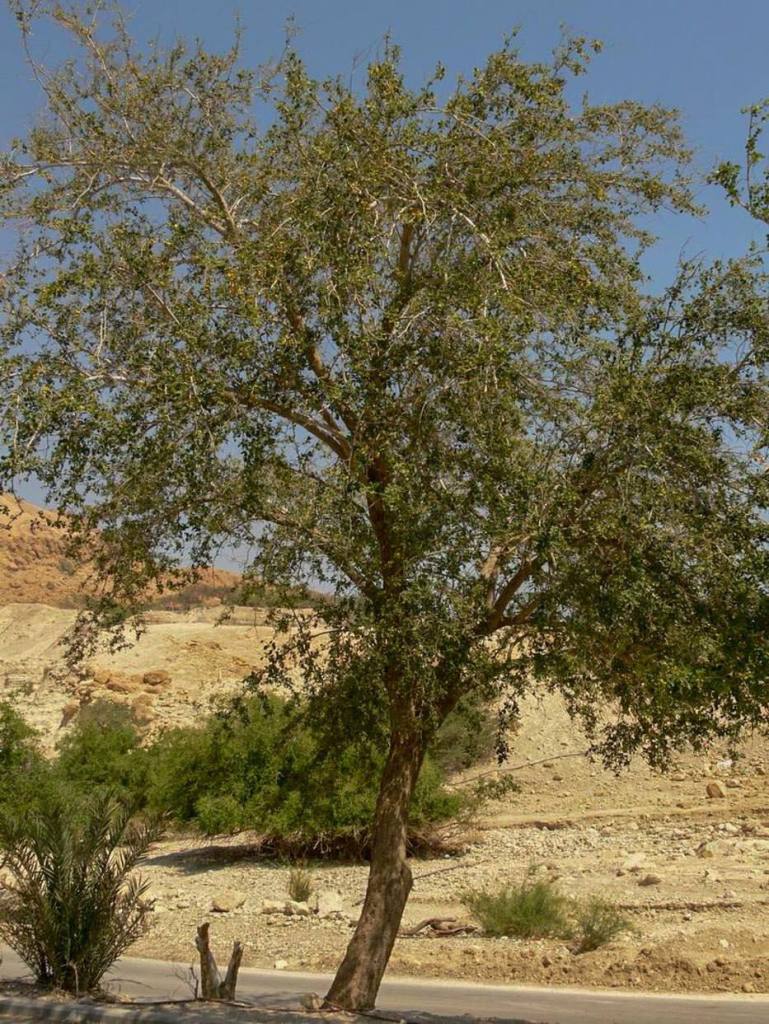
In Hebrew, thorns are commonly translated as qots (קוץ), and thornbush as atad (אטד). The thornbush in the passage from Judges is translated as atad, while in John’s Gospel, the thorns are translated as qots. Interestingly, atad also appears as a place name in Genesis 50:10-11 (translated as Atad in some versions). There is much debate about what kind of plant this atad refers to, but the most plausible candidate is the Ziziphus spina-christi, also known as Ziziphus lotus. This plant is commonly found in northern Israel, particularly on the eastern slopes of the Samarian plain, which matches the location where Jotham delivered his parable of the trees in Judges (the city of Shechem, now known as Nablus in the Palestinian territories). Ziziphus is akin to the jujube tree in Korea, and its fruits are sometimes sold in local markets (note: this is not the same plant as the date palm!). However, it is less commercially valuable than fig or olive trees, which aligns with the context of the parable in Judges. This leads scholars to believe that the Ziziphus tree is likely the atad mentioned.
So, what kind of thornbush was used to make the crown of thorns for Jesus Christ? At least 12 species of thorny plants grow in Jerusalem. One common plant is Sarcopoterium spinosum, also known as the small thorny shrub, which scholars believe was likely used to craft the crown. This plant is a member of the rose family. However, Christian tradition maintains that the Ziziphus tree was used for the crown of thorns, and some people in Jerusalem still preserve this tree on the eastern slope of the Mount of Olives as a memorial. The Ziziphus tree is an evergreen that can grow up to 10 meters tall, with branches that intertwine into an oval, crown-like shape. (This crown-like appearance may be why locals associate it with the crown of thorns.) The tree has oval leaves with serrated edges, measuring 3-5 cm in length and about 2 cm in width. It also has two types of spines—one straight and one hooked. It blooms almost year-round but flowers most abundantly in the summer.
I once heard from a Jewish person about the tree where Judas Iscariot hanged himself while passing by the City Hall tram station in Jerusalem. If you walk down from the station toward Mamilla Street, there is a large tree, which, according to tradition, is the tree where Judas hanged himself. I used to pass this street without giving it much thought, but lately, I find myself thinking about that tree more often. In truth, whether Christ’s crown of thorns was made from the Ziziphus tree or the small thorny shrub doesn’t hold great significance for us. The small thorny shrub is indeed a common sight in Jerusalem. While it used to go unnoticed, now, each time I see it, I am reminded of Christ’s suffering, and my heart humbly reflects on His sacrifice.
As I touch its gnarled thorns, I find myself wondering just how much pain our Lord endured. In the words of poet Kim Chun-su: “When I called his name, he came to me as a flower.” Sometimes, something that seemed ordinary can take on new and profound meaning in our lives.
 Shalom Jerusalem שלום ירושילם