
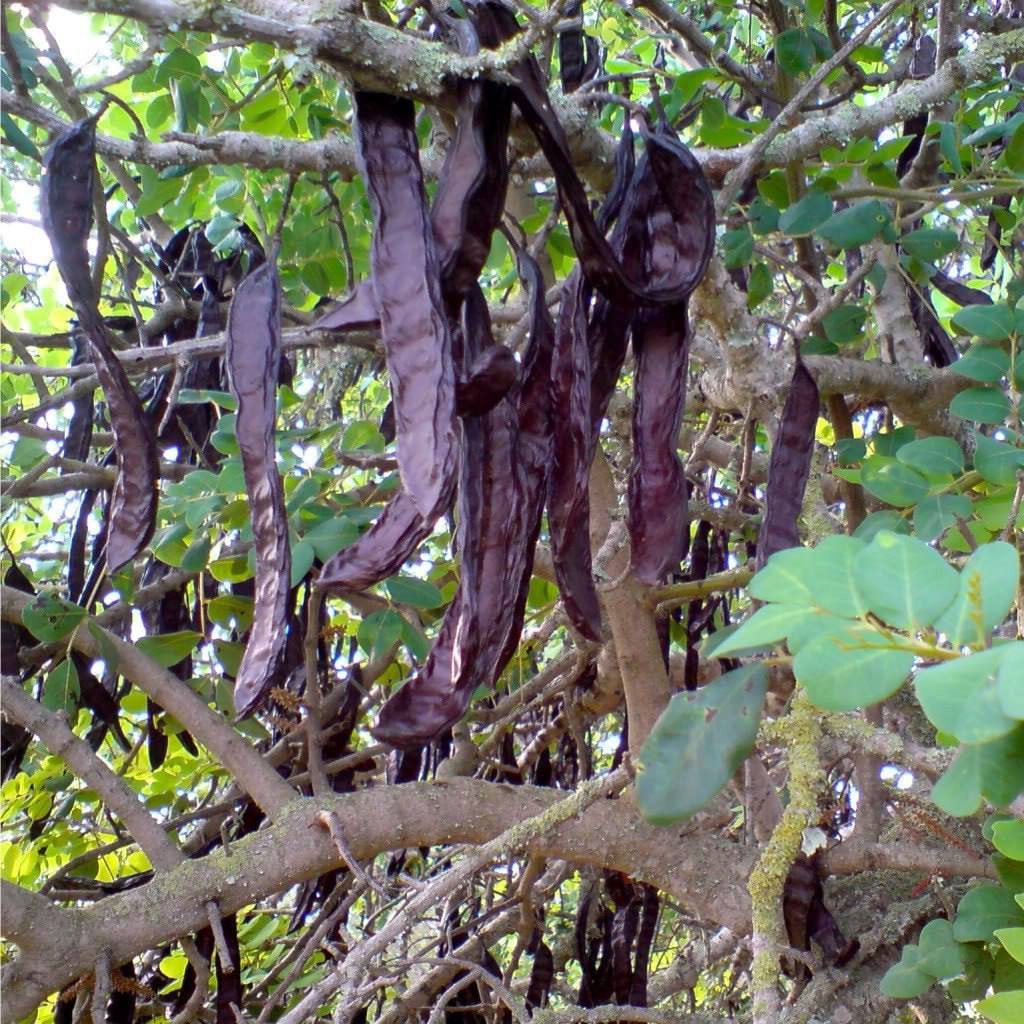
(1) The Carob Tree Fruit
“He longed to fill his stomach with the pods that the pigs were eating, but no one gave him anything. (Luke 15:16)”
The carob tree mentioned in the well-known Parable of the Prodigal Son is a very common plant in Israel, and it is also native to Israel. Despite its prevalence in this land since ancient times, it is surprising that the carob tree is not mentioned in the Old Testament. We can only confirm its existence in this single verse from the New Testament.
However, this plant, called “haruv” (חרוב) in Hebrew, frequently appears in the Talmud and is also common among Arabs in Southwest Asia and North Africa. The Talmud records that the Jewish Rabbi Shimon bar Yochai and his son survived for 12 years on carob tree fruit while hiding in a cave in Galilee, fearing capture by the Romans. The carob tree plays an important role in many plant communities and can be easily found throughout Israel. Its flowers are small and green, blooming in the fall, but its fruit does not ripen until late summer of the following year. The fruit contains many seeds and falls to the ground when ripe. The pulp is used by Arabs to make a type of syrup, with a sugar content usually around 50%. While it is primarily used as animal feed, there are records of people using it as emergency food during times of famine.
It is said that the ancient prophets often carried dried carob tree fruit as an energy bar, similar to a modern-day Snickers bar. This has led to speculation that the food John the Baptist ate was not actually locusts, but carob tree fruit instead. Locusts are called “hagav” (חגב) in Hebrew, and the word sounds similar to “haruv.” For this reason, the fruit is called “Johannisbrod” in German. In a record by Rabbi Wolf on the journey from Bethlehem to Jerusalem, he mentioned, “There were many trees along the way that the locals called ‘haruvi,’ and we called the fruit John the Baptist’s bread.”
In fact, the carob tree fruit itself does not hold significant biblical importance. However, whenever we see this fruit, which is commonly found in Israel, we are reminded of the Parable of the Prodigal Son. Even now, our Lord is waiting with longing at the village outskirts for His lost son to return. Today, as we look at the carob tree fruit that has withered out of season, we try to understand even a little bit of the Father’s heart.
🔺Next Episode Preview: What tree was the Crown of Thorns made from?
 Shalom Jerusalem שלום ירושילם